> For the complete documentation index, see [llms.txt](https://docs.popl.co/introduction/llms.txt). Markdown versions of documentation pages are available by appending `.md` to page URLs; this page is available as [Markdown](https://docs.popl.co/introduction/integrations/hubspot-integration/hubspot-field-mapping.md).
# HubSpot Field Mapping
You can set up field mappings to ensure your Popl Lead data ends up where you need it in your CRM. You can setup field mappings for the contact object in HubSpot.
To start setting up your field mappings click into the Contacts field tab in your integration settings.
The following are the default Lead mappings. You can customize these mappings to include lead qualifiers and enriched data.
| Popl Field | HubSpot Field |
| ---------------------------------------------------------------------------- | ------------- |
| first name | First Name |
| last name | Last Name |
| email | Email |
| job title | Job Title |
| company | Company |
| number | Phone Number |
| Contact Owner (will be the member that connected with that contact via Popl) | Contact Owner |
**Note: The *****Record Source***** field in HubSpot is automatically populated by HubSpot to show the origin of a contact. You do not need to map this field from Popl. HubSpot will fill it in for you.**
#### Customize your Field Mappings
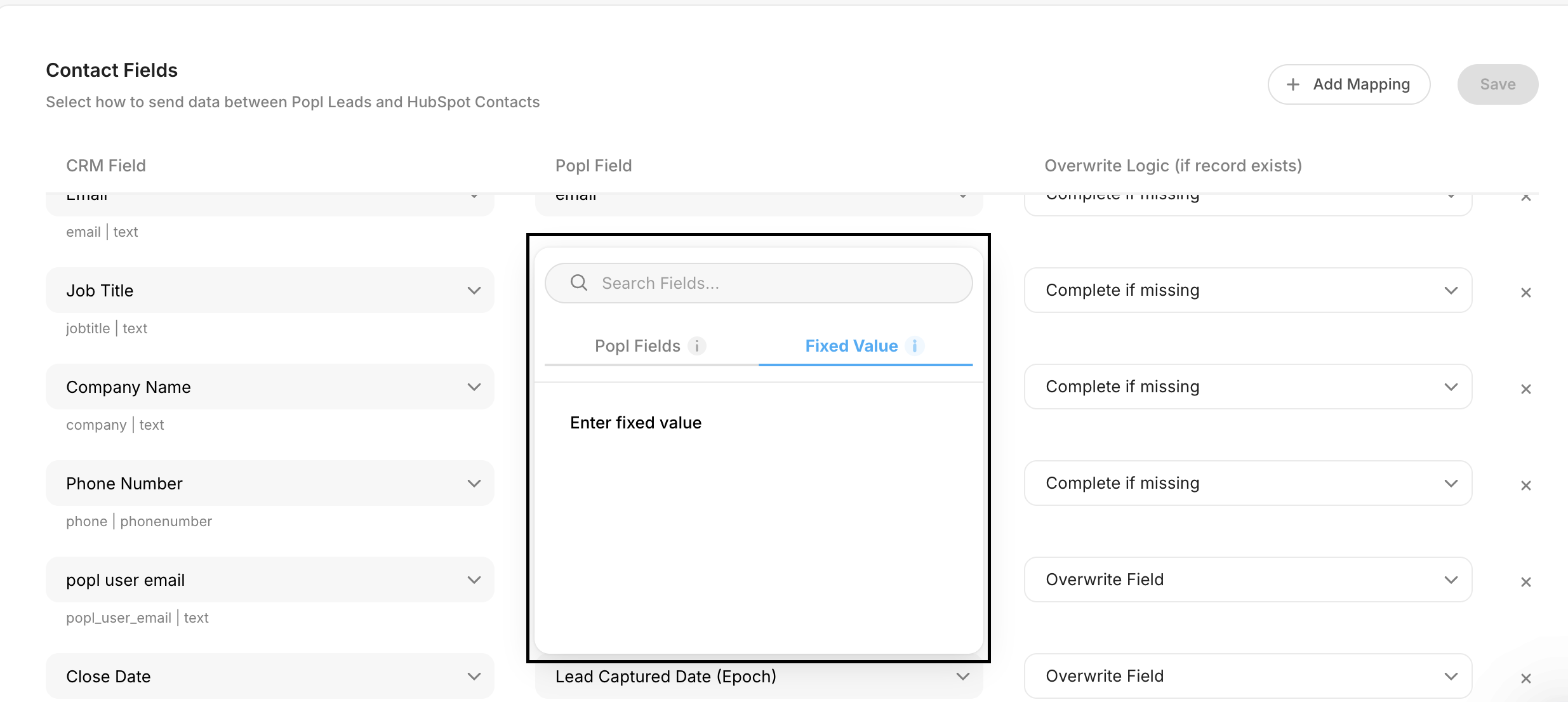
You can modify or replace the default mappings with your own custom mappings including lead qualifiers and enriched data. To add a new field mapping, click **Add Mapping** in the top-right corner of the Contact field mapping tab.
#### Sync Logic For Contacts
After choosing which fields you want to map, you can adjust the sync behavior. You can choose between overwrite, complete if missing, or append.
**Overwrite field:** If a value already exists for an object in HubSpot, replace that data with the Popl field.
**Complete if missing:** Only use the Popl value if the existing field is empty. Otherwise leave the field value as is in HubSpot.
**Append:** Add Popl values to fields that may already have data, instead of replacing it.
***
#### Mapping Types
**Dynamic Mappings -** Dynamic mappings allow Popl to send **real-time data** from each individual contact into the corresponding HubSpot field. This means the value that syncs will **change based on the information captured** during the lead exchange.Use dynamic mappings when you want HubSpot fields to reflect unique data for every synced record.
**Fixed Mappings** - Fixed mappings allow you to send the **same preset value** to a HubSpot field for every synced record. To set a fixed mapping, click into the Popl field, select **“Fixed Mapping,”** and enter the constant value you want applied to all synced contacts. Use fixed mappings when you need a **consistent, unchanging value.**
***
#### Save Settings
Once you have configured your field mappings, be sure to save your changes. You can do this by clicking **Save** in the top-right corner of the contact mapping tab.
Once your mappings and sync behaviors are set, your integration runs seamlessly, automatically delivering the right data to the right HubSpot fields every time.
***
#### Need Help?
Contact Popl Support – our team is available to assist at .
\
With 🤍 from Popl.